- Real cases out there
- Risks of poisoning
Address poisoning attacks, a kind of fraud intended to fool people into transferring money to the incorrect wallet, are becoming more common among Ethereum users. Although the technique has been around for a while, new data indicates that these attacks are now much more automated and pervasive, transforming what was previously sporadic spam into a massive operation.
Real cases out there
The issue is exemplified by a recent instance. Nima, an Ethereum user, claimed to have received over 89 Etherscan Address Watch alerts just after transferring only two stablecoins. Numerous small transactions that were sent to the wallet caused the alerts. These transfers were a part of an address poisoning campaign, not actual payments.
 Source: Etherscan
HOT Stories
Billionaire Druckenmiller Claims Crypto Could Be New Reserve Currency
Crypto Market Review: Unexpected Shiba Inu (SHIB) Breakout Recorded, Cardano (ADA) Grinds to Yearly Bottom, Is $71,000 Flashing on Bitcoin’s (BTC) Horizon?
The process of address poisoning has a straightforward objective: to add fictitious lookalike addresses to a user’s transaction history. Attackers keep an eye on blockchain activity and wait for transactions that are legitimate.
Automated systems create addresses that resemble the initial and final characters of previously used wallets after a user sends money. Then small transactions — typically dust transfers worth less than a cent — are sent using these fake addresses. The fictitious address shows up in the history since many wallets and explorers display recent transactions prominently.
Risks of poisoning
The user may inadvertently copy the poisoned address rather than the correct one when they wish to send money again later. The scope of these assaults is substantial
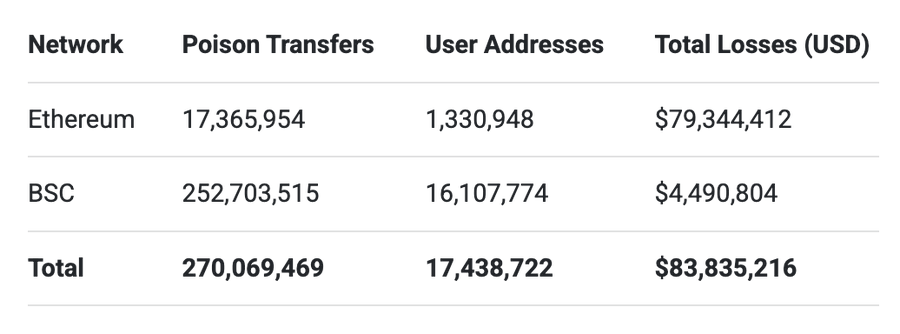
Approximately 17 million poisoning attempts were made against approximately 1.3 million Ethereum users between July 2022 and June 2024, with confirmed losses exceeding $79 million, according to a 2025 study.
The primary cause behind the rise in these attacks is basic economics. According to research, the success rate of a poisoning attempt is only approximately 0.1%, or one successful scam out of every 10,000 attempts. Attackers, however, make up for it by sending a large quantity of poison transfers
Additionally, lower network fees have contributed. Transaction costs decreased after Ethereum’s Fusaka upgrade, making it less expensive for attackers to send thousands or even millions of dust transactions
Disclaimer: The information on this page may come from third parties and does not represent the views or opinions of Gate. The content displayed on this page is for reference only and does not constitute any financial, investment, or legal advice. Gate does not guarantee the accuracy or completeness of the information and shall not be liable for any losses arising from the use of this information. Virtual asset investments carry high risks and are subject to significant price volatility. You may lose all of your invested principal. Please fully understand the relevant risks and make prudent decisions based on your own financial situation and risk tolerance. For details, please refer to
Disclaimer.
Gerelateerde artikelen
Ethereum Spot ETFs See $101M Net Inflows Yesterday, Fidelity FETH Leads With $49.4M
According to SoSoValue data cited by ChainCatcher, Ethereum spot ETFs saw net inflows of $101 million yesterday (May 1). Fidelity's FETH led with $49.39 million in single-day net inflows, followed by BlackRock's ETHA with $43.16 million. The total net asset value of Ethereum spot ETFs
GateNews26m geleden
Hundreds of Dormant Ethereum Wallets Drained by Single Address
According to ChainCatcher, citing analyst Wazz, hundreds of dormant Ethereum wallets, many inactive for over seven years, were drained by the same address on ETH mainnet. Aragon team member @TheTakenUser confirmed their wallet was affected. The root cause remains unclear, though community analysis s
GateNews50m geleden
Ethereum Foundation Sells 10,000 ETH to Bitmine for $23 Million, Bringing Weekly Total to $47 Million
According to The Block, the Ethereum Foundation sold 10,000 ETH to Tom Lee's Bitmine Immersion Technologies on Friday, valued at approximately $23 million. The transaction occurred exactly one week after the foundation sold another 10,000 ETH worth roughly $24 million to the same buyer. Bitmine paid
GateNews2u geleden
Hyperliquid Whales Hold $3.914B in Positions With 1.03 Long-to-Short Ratio
According to Coinglass data, whales on Hyperliquid currently hold $3.914 billion in positions with a 1.03 long-to-short ratio. Long positions total $1.982 billion (50.64% of holdings) while short positions stand at $1.932 billion (49.36%). A major whale address initiated a 20x leveraged long positio
GateNews3u geleden
Trader Realizes 183x Returns on ASTEROID in 15 Days, Turns 3 ETH into 550 ETH
According to PANews, on May 3, a trader identified as 0xaA5 turned 3 ETH into 550 ETH in 15 days through trading the ASTEROID token. The trader purchased 4.28 billion ASTEROID tokens with 3 ETH, then sold the entire position for 550 ETH (approximately $1.27 million), achieving a 183x
GateNews3u geleden
Ethereum Foundation Sells 10,000 ETH to Bitmine for $23M on Friday, Cumulative $47M in Week
According to The Block, the Ethereum Foundation sold 10,000 ETH valued at approximately $23 million to Tom Lee's Bitmine Immersion Technologies on Friday, bringing the total ETH sales to Bitmine to roughly $47 million within a week. The latest transaction occurred at an average price of $2,292.15 pe
GateNews8u geleden


